Billy: Unleashing Industrial Aggression Through Premium Blackletter Typography
Typography is rarely just about legibility; in the realms of counter-culture and high-impact branding, it is about visceral attitude. Billy arrives not as a polite suggestion but as a demand for attention. This premium display font dismantles the polite boundaries of traditional typography, fusing the historical weight of blackletter structure with a raw, industrial aggression that feels distinctly modern. For designers and brand owners operating in spaces where safety is the enemy, Billy offers a visual voice that is sharp, rebellious, and unapologetically loud.
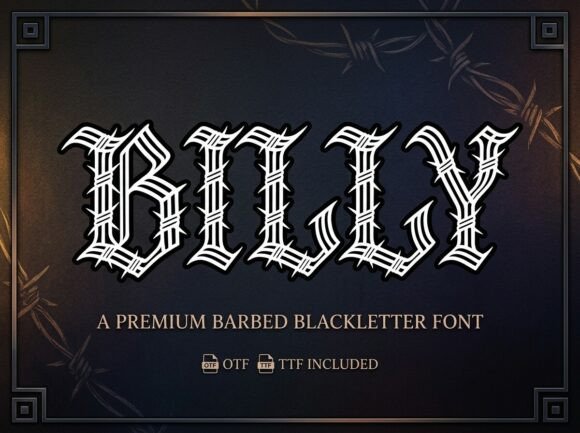
The typeface is defined by its rhythmic, triple-lined letterforms. Unlike standard gothic revivals that rely on solid fills or simple outlines, Billy constructs each character through a complex interplay of lines bound by what can only be described as a vicious-wire soul. Every curve and straight edge is accented by sharp, dangerous barbs, transforming the alphabet into a series of visual hazards. This is not a font for body copy or corporate annual reports. It is a specialized tool for independent streetwear branding, heavy metal aesthetics, custom motorcycle graphics, and underground social media identities that require immediate, commanding presence.
The Anatomy of Visual Danger
To understand why Billy performs so effectively in niche markets, one must look at its construction. The triple-line system creates a sense of depth and vibration that single-weight fonts cannot achieve. When scaled up for a hoodie back print or an album cover, these lines create a texture that mimics industrial cabling or barbed wire fencing. The "vicious-wire" aesthetic is not merely decorative; it provides structural integrity to the letterforms, preventing them from looking like costume-party gothic. Instead, they read as engineered artifacts.
The barbs serve a dual purpose. Visually, they add a kinetic energy, making static text appear as though it is snagging on the viewer’s gaze. Practically, they create distinct negative space patterns that help the type remain legible even when distressed, textured, or overlaid on chaotic photography. In streetwear design, where garments are often photographed in motion or low light, this inherent contrast ensures the brand name cuts through visual noise. The sharpness of the accents also dictates the mood; there are no soft terminals in Billy. Every endpoint is a weaponized decision, reinforcing the rebellious energy that defines the alternative aesthetic.
Streetwear and the Economics of Exclusivity
Independent streetwear thrives on scarcity and identity. Mass-market brands utilize clean sans-serifs to appeal to everyone; indie labels use typography like Billy to signal belonging to a specific tribe. When applied to apparel, Billy functions as a filter. Its aggressive blackletter roots tap into a lineage of punk, metal, and biker culture, instantly communicating values of non-conformity and authenticity. The triple-lined detail adds a layer of perceived value. On a garment tag or a chest print, the complexity of the font suggests craftsmanship and intentionality, distinguishing the piece from generic graphic tees.
Designers working in this space should consider the scalability of Billy’s barbs. While the font shines at massive scales, the intricate line work requires careful handling during production. Screen printing with high mesh counts or utilizing direct-to-garment (DTG) technology preserves the sharpness of the wire-like forms. Embroidery is another powerful application; the triple lines translate exceptionally well to stitch paths, creating a tactile, raised surface that enhances the industrial feel. However, simplification may be necessary for small-scale embroidery to prevent thread buildup. Understanding these production realities ensures that the digital aggression of Billy translates faithfully to physical merchandise.
Sonic Branding: Metal Covers and Motorcycle Graphics
Heavy music and custom automotive cultures share a DNA of intensity and precision. Billy was practically forged for these environments. On album artwork, the font’s dangerous barbs mirror the sonic distortion and rhythmic complexity of the music itself. Art directors can leverage the triple-lined structure to create typographic treatments that interact with band photography, weaving the text through imagery rather than simply placing it on top. The font’s high-impact weight holds its own against dark, high-contrast visuals common in metal and hard rock genres, ensuring the band name remains the focal point even amidst visual chaos.
In the world of custom motorcycles and hot rods, typography must compete with chrome, paint, and mechanical complexity. Billy’s industrial aggression complements the raw mechanics of exposed engines and welded frames. The font looks native on fuel tanks, helmet visors, and shop signage because it shares the same language of fabrication. Pinstripers and airbrush artists will find the rhythmic flow of the letterforms conducive to hand-painting, while vinyl cutters can utilize the sharp edges for bold, weedable decals. The key here is integration; Billy shouldn't look pasted onto a bike. It should look like it was machined as part of the assembly.
Digital Dominance in Underground Spaces
Social media headers and profile assets are the digital storefronts for underground brands. In a feed dominated by algorithmic sameness, Billy acts as a pattern interrupt. The high-impact weight ensures readability on mobile screens, while the unique triple-line texture prevents the text from flattening out against compressed backgrounds. For Instagram, TikTok, or YouTube banners, the font’s horizontal rhythm guides the eye across the frame, making it ideal for channel art that needs to convey information quickly without sacrificing edge.
- Contrast Management: Pair Billy with stark, minimalist backgrounds or gritty, high-noise textures. Avoid mid-tone clutter that competes with the triple lines.
- Kerning Awareness: The barbs extend beyond standard bounding boxes. Manual kerning is essential to prevent overlapping hazards while maintaining the tight, locked-up tension typical of streetwear layouts.
- Color Strategy: High-contrast duotones (black/white, neon/black) maximize the wire-frame effect. Gradients can be used within the triple lines to add dimensionality without losing the sharp silhouette.
- Motion Graphics: The linear structure of Billy lends itself to animation. Revealing the letterforms line-by-line or having the barbs "snag" into place reinforces the industrial narrative in video content.
Practical Considerations for Adoption
Choosing Billy is a commitment to a specific tonal range. Before integrating it into a project, assess whether the brand’s voice truly aligns with industrial aggression. This is not a versatile workhorse; it is a specialist. If the goal is approachability or luxury refinement, Billy will send the wrong signal. However, if the objective is to disrupt, provoke, or assert dominance in a saturated market, few typefaces deliver with such focused intent.
Licensing and usage rights are also critical factors for commercial projects. As a premium display font, Billy represents an investment in brand differentiation. Ensure that the license covers all intended mediums, particularly merchandise and large-format print, which often have different tiers than digital-only use. Additionally, test the font extensively in context before finalizing designs. What looks powerful on a 27-inch monitor may lose its barb definition on a business card or a small web banner. Establish minimum size guidelines to preserve the integrity of the triple-lined structure.
Ultimately, Billy succeeds because it refuses to compromise. It takes the historical authority of blackletter and strips away the antiquated nostalgia, replacing it with a contemporary, hazardous edge. For the independent creator, the metal label, or the custom builder, this typeface offers more than letters; it offers a posture. In an era of sanitized design, adopting Billy is a declaration that your work exists outside the safe zone, built with the same sharp, uncompromising materials as the culture it represents.