Adventure Awaits with Sepia: Redefining Visual Identity in the Outdoor Economy
In the rapidly evolving landscape of outdoor lifestyle branding, the line between digital utility and organic authenticity has become increasingly blurred. Modern consumers are no longer satisfied with sterile corporate aesthetics; they crave visual narratives that evoke the tactile sensation of pine needles, the ruggedness of granite, and the nostalgic warmth of analog exploration. Enter Sepia, a breathtaking display typeface that captures a wild-and-wanderlust soul through structural innovation rather than mere decoration. This is not simply a font choice; it is a strategic design asset for professionals seeking to bridge the gap between vintage National Park badges and modern outdoor lifestyle branding.
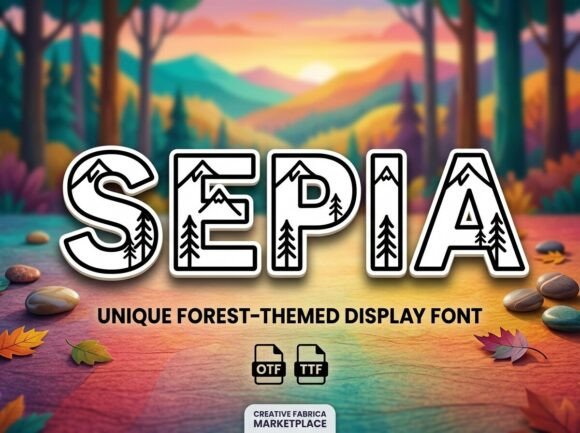
For entrepreneurs, marketers, and creative directors operating within the adventure sector, typography serves as the primary vessel for brand sentiment. Sepia distinguishes itself by featuring massive, bold letterforms uniquely characterized by rhythmic, hand-drawn mountain-and-pine illustrations integrated directly into the structure of every character. This integration transforms standard text into immediate iconography, addressing a critical need in today’s attention-scarce digital environment where visual shorthand is paramount.
The Convergence of Nostalgia and Modern Utility
To understand why Sepia is resonating so deeply with contemporary audiences, one must examine the broader trajectory of consumer preferences in the post-digital age. We are witnessing a significant shift away from the hyper-minimalism that dominated tech and lifestyle branding in the early 2010s. While clean sans-serifs offered scalability, they often sacrificed personality. Today’s market favors "new nostalgia"—a design philosophy that leverages historical cues to build trust while utilizing modern production standards to ensure clarity.
Sepia sits precisely at this intersection. It channels the authoritative, sturdy aesthetic of mid-century park signage and expedition journals, yet it is engineered for high-resolution screens and responsive layouts. For independent camping gear identities and boutique eco-tourism logos, this duality is essential. The font communicates heritage and durability without appearing outdated or illegible on mobile devices. It satisfies the consumer's desire for authentic connection while meeting the marketer's requirement for functional versatility.
Beyond Decoration: Illustration as Structure
A common pitfall in thematic typography is the reliance on superficial embellishments. Many "outdoor" fonts merely place clip-art trees above letters or add rough textures as an overlay. Sepia takes a fundamentally different approach by embedding the illustration within the glyph itself. The mountain peaks and pine boughs are not accessories; they are the strokes. This architectural integration ensures that the typeface maintains its readability even when scaled down for social media bios or embroidered onto technical apparel.
This structural integrity is what makes Sepia the premier choice for high-impact scenic-and-sturdy social media headers. In platforms like Instagram and TikTok, where the header image acts as a billboard, the typeface must perform double duty: identifying the brand and setting the emotional tone simultaneously. By merging form and meaning, Sepia reduces visual clutter, allowing creators to communicate complex brand values instantly.
Strategic Applications Across the Adventure Sector
The relevance of Sepia extends beyond aesthetic preference; it solves specific workflow and identity challenges across various verticals within the outdoor industry. Understanding these practical applications helps professionals leverage the typeface more effectively.
- Independent Camping Gear Identities: For DTC (Direct-to-Consumer) brands competing against legacy giants, distinctiveness is survival. Sepia provides instant shelf presence and digital recognition. Its bold weight holds up well on product packaging, hang tags, and embossed leather patches, reinforcing a perception of quality and craftsmanship.
- Boutique Eco-Tourism Logos: Sustainability-focused travel operators need to signal environmental stewardship without resorting to cliché green leaf motifs. Sepia’s integrated nature elements feel inherent rather than applied, suggesting that respect for the landscape is foundational to the business model, not just a marketing afterthought.
- Adventure Photography Watermarks: Photographers face the perennial challenge of protecting intellectual property without distracting from the art. Because Sepia’s letterforms contain their own internal detail, they function as effective watermarks that complement rather than compete with complex landscape imagery. The texture of the font harmonizes with natural scenes, making the attribution feel like part of the composition.
- Event and Festival Branding: From trail running races to overlanding expos, event organizers require typography that conveys energy and scale. Sepia’s massive proportions command attention on banners, race bibs, and wayfinding signage, ensuring legibility from a distance while maintaining thematic cohesion.
Adapting to Changing Content Workflows
The modern creative workflow is faster and more fragmented than ever before. Designers and freelancers are often tasked with producing assets for five different platforms in a single afternoon. In this context, efficiency is a creative virtue. Sepia streamlines the ideation process by eliminating the need for separate illustrative elements. When the headline is the illustration, the designer saves time on sourcing stock vectors or commissioning custom artwork for every campaign iteration.
Furthermore, the rise of template-based design tools and AI-assisted workflows has democratized access to professional aesthetics, but it has also led to homogenization. Using a distinctive display typeface like Sepia acts as a differentiator in a sea of generic templates. It signals intentionality. When a potential client or customer encounters Sepia, they recognize that the brand has made a deliberate typographic choice, which subconsciously elevates the perceived value of the offering.
The Psychology of Rugged Typography
Why do people pay attention to this specific style of lettering? The answer lies in sensory psychology. In an era dominated by smooth glass screens and intangible digital experiences, there is a profound psychological hunger for texture and weight. Sepia’s hand-drawn characteristics trigger haptic associations. Even when viewed on a retina display, the irregularities and organic lines suggest physical interaction—carved wood, stamped metal, or ink pressed into textured paper.
This sensory engagement is crucial for conversion in the outdoor sector. Consumers are not buying tents, tours, or photographs; they are buying the anticipation of experience. Adventure awaits with Sepia because the font itself acts as a portal to that experience. It primes the viewer’s imagination before they have read a single word of copy. For marketers, this means higher engagement rates and stronger emotional retention. The typeface does the heavy lifting of establishing atmosphere, allowing the accompanying text to focus on logistics, features, and calls to action.
Navigating Accessibility and Hierarchy
While Sepia is a powerful tool for headlines and display purposes, professional application requires mindfulness regarding hierarchy and accessibility. As a display typeface with intricate internal details, it is designed for short-form, high-impact usage. It is not suitable for body copy or long-form reading.
Best practice involves pairing Sepia with a highly legible, neutral sans-serif or a clean geometric slab serif for supporting text. This contrast amplifies Sepia’s decorative qualities while ensuring that essential information remains accessible to all users, including those with visual impairments. Furthermore, designers must be vigilant about color contrast. Because the letterforms contain internal negative space (the mountain and tree shapes), using low-contrast color combinations can compromise legibility. Testing against WCAG guidelines is essential to ensure that the adventurous spirit of the brand does not come at the cost of inclusivity.
Future-Proofing Brand Identity
Trends in the outdoor industry cycle quickly, but the fundamental human connection to nature remains constant. Sepia’s success lies in its ability to tap into this timeless current while adhering to contemporary design standards. It avoids the trap of being overly trendy or meme-centric. Instead, it anchors itself in the enduring visual language of exploration.
For freelancers and agencies advising clients, recommending Sepia is a forward-looking move. It positions brands within the growing "slow living" and "intentional travel" movements, which prioritize depth over speed. As augmented reality and immersive web experiences continue to develop, typefaces with strong structural character will become even more valuable. They provide the necessary visual anchor points in increasingly fluid digital environments.
Ultimately, Sepia represents more than a collection of glyphs; it is a response to a cultural moment. It acknowledges that while our tools have changed, our longing for the wild has not. For the professional creator, it offers a sophisticated vocabulary to articulate that longing. Whether defining the identity of a new glamping site or refreshing the watermark of a seasoned alpinist photographer, Sepia delivers a promise of authenticity that resonates deeply with the modern explorer. In a crowded marketplace, it ensures that when adventure awaits, your brand is the first thing seen and the last thing forgotten.