Chiku: Redefining Modern Aesthetics with Geometric Precision
In the crowded landscape of digital typography, finding a display font that balances artistic expression with structural integrity is a rare achievement. Chiku emerges as a definitive answer for designers seeking to redefine modern aesthetics without sacrificing legibility or purpose. This sleek display typeface captures a minimalist-and-mathematical soul that resonates deeply with contemporary visual culture. It is not merely a collection of glyphs; it is a design system built on rhythmic, octagonal angles and high-contrast letterforms that command attention while maintaining an air of sophisticated restraint.
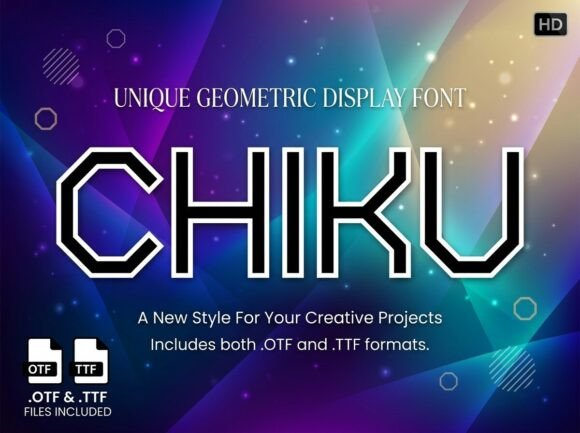
For professionals ranging from independent architects to tech editors, the choice of typeface often dictates the perceived value of the content. Chiku distinguishes itself through a clean white inline that radiates contemporary sophistication, creating a dual-tone effect even in single-color applications. This intrinsic detail adds depth and texture to headlines without requiring complex post-processing or layering effects. When you select Chiku, you are opting for a tool that bridges the gap between raw geometric abstraction and refined editorial elegance.
The Anatomy of Mathematical Minimalism
Understanding why Chiku works requires looking at its construction. Unlike traditional serifs that rely on historical calligraphy or grotesque sans-serifs that prioritize uniform neutrality, Chiku operates on a distinct mathematical grid. The letterforms are defined by thin, high-contrast strokes that terminate in sharp, octagonal cuts. This geometry creates a visual rhythm that guides the eye across the page or screen with predictable precision.
The "mathematical soul" of the font is evident in its consistent stroke modulation. There is no arbitrary variation; every curve and angle serves a structural purpose. This makes Chiku exceptionally stable in large-format printing and responsive web environments. The precise structural weight ensures that the font does not disappear against busy backgrounds nor overwhelm negative space. For designers who obsess over alignment and grid systems, Chiku feels less like a decorative element and more like an architectural component of the layout itself.
Strategic Applications in Professional Branding
Versatility in display typography is often a euphemism for being generic, but Chiku offers specific utility across distinct industries. Its sharp personality and technical aesthetic make it a premier choice for sectors where precision implies trust.
- Independent Architecture: Architectural firms often struggle to find branding that mirrors their built work. Chiku’s octagonal angles and structural clarity echo blueprints and modernist facades. It pairs exceptionally well with photography-heavy portfolios, providing a textual anchor that complements rather than competes with spatial imagery.
- High-End Tech Editorials: Technology publications require typography that signals innovation without descending into sci-fi cliché. Chiku’s clean white inline suggests circuitry and data flow subtly, making it ideal for feature headlines, pull quotes, and section dividers in digital magazines covering AI, hardware, or software development.
- Modern Fashion Logos: In fashion, typography must convey luxury and trend awareness simultaneously. The high-contrast nature of Chiku aligns with current luxury minimalism trends. Its sharp terminals provide enough edge for streetwear brands while retaining the refinement necessary for haute couture lookbooks.
- Social Media Headers: On platforms like LinkedIn, X, or Instagram, readability at small sizes is paramount. Chiku’s bold geometric skeleton remains distinct even when scaled down for mobile viewing, ensuring brand recognition in crowded feeds.
Enhancing User Experience Through Typographic Hierarchy
Beyond aesthetics, Chiku solves practical communication challenges. In user interface design and editorial layouts, establishing a clear hierarchy is essential for engagement. Display fonts often fail because they are too ornate to function as signposts. Chiku, however, leverages its high contrast to create immediate focal points. The thin strokes allow for tight tracking in uppercase settings without causing ink bleed or pixelation, while the octagonal forms provide unique word shapes that aid rapid scanning.
This efficiency translates directly to user experience. When a reader encounters a headline set in Chiku, the brain processes the geometric consistency as organized information. This reduces cognitive load, allowing the audience to focus on the message rather than deciphering the medium. For educators and publishers creating course materials or textbooks, this clarity helps break up dense content blocks, making complex subjects feel more approachable and structured.
Practical Considerations for Implementation
While Chiku is a powerful asset, it demands respectful handling to achieve its full potential. As a specialized display typeface, it is not designed for body copy. Attempting to use it for paragraphs will result in fatigue and reduced accessibility. Instead, treat Chiku as the lead instrument in your typographic orchestra.
Pairing is critical. Because Chiku possesses such a strong, angular identity, it harmonizes best with neutral, humanist sans-serifs or classic transitional serifs for body text. A rounded geometric sans might clash with Chiku’s sharpness, while a highly decorative serif could create visual noise. Let Chiku handle the titles, captions, and navigational elements, while a quieter typeface manages the long-form reading experience.
Color usage also warrants strategic thought. The white inline feature shines brightest in dark mode environments or against solid, muted backgrounds. Inverse color schemes (light text on dark background) amplify the font's technical feel, whereas black-on-white emphasizes its editorial crispness. Designers should test Chiku across intended mediums before finalizing assets; what looks striking on a 4K monitor may need optical adjustments for newsprint or low-resolution fabric printing.
The Value of Distinctive Visual Identity
In an era of template-driven design, distinctiveness is a competitive advantage. Businesses and creators using Chiku signal a commitment to intentional design choices. This font moves beyond the safe neutrality of standard system fonts, offering a bespoke quality that elevates perceived brand value. For freelancers and agencies, specifying Chiku in a style guide demonstrates a sophisticated understanding of how form influences perception.
Furthermore, the font’s mathematical foundation future-proofs designs. Trends come and go, but geometry endures. Chiku avoids the ephemeral stylistic quirks that date designs within months. Its reliance on fundamental proportions ensures relevance across evolving digital standards and print technologies. Whether you are designing a mobile app interface, a conference banner, or a personal portfolio, Chiku provides a timeless yet thoroughly modern framework.
Ultimately, selecting a typeface is an exercise in defining voice. Chiku speaks with clarity, precision, and confidence. It strips away the unnecessary to reveal the essential structure of communication. For those ready to move past conventional aesthetics and embrace a sharper, more calculated approach to visual storytelling, Chiku offers the perfect foundation. It is more than a font; it is a declaration of modern intent, tailored for professionals who understand that true sophistication lies in the details.