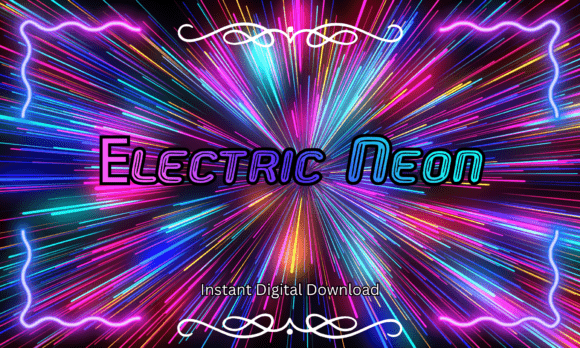
Electric Neon: Elevating Digital Design with Glowing Typography
In the crowded landscape of digital content, capturing attention within seconds is a primary challenge for designers and marketers. Standard typography often fails to convey the specific energy required for gaming, nightlife, or futuristic branding without extensive post-processing. Electric Neon addresses this gap by integrating lighting effects directly into the font structure. This display typeface is engineered to simulate the luminance of gas-discharge tubes and LED signage, providing an immediate visual hook that standard flat fonts cannot achieve on their own. For creators working in cyberpunk aesthetics, stream graphics, or high-impact social media, understanding how to leverage this specific typographic style can significantly reduce production time while increasing visual engagement.
Streamlining Visual Impact for Dark Interfaces
The most practical application of Electric Neon lies in its optimization for dark backgrounds. In user interface design and digital art, achieving a realistic glow effect typically requires layering multiple text objects with varying opacities and blur radii. This process is time-consuming and can create large file sizes or rendering lag in motion graphics. Electric Neon simplifies this workflow by embedding the gradient and luminosity into the glyph itself. When placed against a black or deep charcoal background, the font activates visually without requiring external layer styles. This efficiency is particularly valuable for streamers designing overlays or social media managers creating daily content where turnaround time is critical. The built-in vibrancy ensures that headlines remain legible and striking even when scaled down for mobile viewing, solving a common issue where neon effects lose definition at smaller sizes.
Enhancing Brand Identity in Gaming and Entertainment
Gaming logos and entertainment branding demand a specific visual language that communicates excitement and modernity. Generic bold sans-serif fonts often feel too corporate or sterile for these niches. Electric Neon provides a stylistic shortcut to the "arcade" or "cyber-future" aesthetic that resonates with audiences aged 20 to 50. For indie game developers or Twitch streamers, establishing a cohesive visual identity is essential for community building. Using this font for channel names, logo watermarks, or merchandise creates instant thematic consistency. The uppercase letterforms are designed with geometric precision that maintains readability despite the decorative glow, ensuring that brand names are recognizable across different platforms, from YouTube thumbnails to embroidered caps. This balance between stylization and function prevents the design from sacrificing clarity for the sake of atmosphere.
Technical Versatility Across Print and Digital Media
A frequent limitation of novelty fonts is poor cross-platform compatibility. Electric Neon mitigates this risk by providing both TTF (TrueType Font) and OTF (OpenType Font) formats. This dual-format inclusion ensures that the font renders correctly whether you are designing a vector-based poster in Adobe Illustrator or editing a raster image in Photoshop. For print applications like flyers, stickers, or packaging, the OTF format generally offers superior hinting and scaling, preserving the crisp edges of the neon simulation during high-resolution output. Conversely, the TTF format ensures broad compatibility with video editing software and web-based design tools. Professionals should note that while the font includes numbers and symbols, it is strictly uppercase. This limitation is intentional, as lowercase neon tubing is historically rare and visually cluttered. Designers must plan their hierarchy accordingly, perhaps pairing Electric Neon with a clean, neutral sans-serif for body copy to maintain professional standards and accessibility.
Commercial Application and Licensing Considerations
For freelancers and small business owners, licensing is a critical operational concern. Many free neon-style fonts restrict commercial use, exposing users to legal risks when selling merchandise or monetizing content. Electric Neon includes commercial usage rights upon purchase, allowing for immediate integration into client projects, product packaging, and paid advertising campaigns. This removes the administrative burden of negotiating separate licenses or attributing authors on every deliverable. However, users must understand the distinction between the font file and the preview mockups. The vibrant gradients seen in promotional materials are often enhanced by the software environment. While the font contains the core color data, achieving identical results in print may require selecting appropriate paper stocks or adjusting CMYK values, as digital RGB glows do not always translate perfectly to physical ink. Understanding this technical nuance prevents disappointment and ensures the final product meets professional quality standards.
Optimizing Readability Within Stylized Typography
Decorative fonts often suffer from poor legibility, but Electric Neon prioritizes strong structural forms alongside its aesthetic effects. The weight distribution is calibrated to prevent the "glow" from bleeding into the negative space between letters, which is a common failure point in neon typography. This makes it suitable for short-form communication such as headlines, call-to-action buttons, and event titles. However, it is not designed for long-form reading. Attempting to use this typeface for paragraphs or dense information blocks will cause eye strain and reduce comprehension. The strategic value of Electric Neon is its role as a focal point. It works best when used sparingly to guide the viewer’s eye to the most important element of the composition. By treating it as a graphical element rather than traditional text, designers can maximize its impact without compromising the overall user experience or information architecture of the project.
Practical Workflow Integration for Modern Creators
Integrating Electric Neon into a creative workflow requires an understanding of digital asset management. As an instant digital download, the files are immediately available for installation, supporting agile project timelines. For educators teaching design principles or hobbyists exploring cyberpunk art, this font serves as an excellent case study in how texture and light can be simulated through vector shapes. It demonstrates that complex visual effects do not always require raster painting or 3D rendering. However, users should be aware that because this is a digital-only product, there is no physical signage component. The value is entirely contained within the software application. For those seeking to recreate specific color variations not present in the default font file, standard design software allows for recoloring the glyphs, provided the base luminosity structure is respected. This flexibility allows the font to adapt to various brand color palettes while retaining its signature electric character.
Ultimately, Electric Neon serves as a specialized tool for specific communicative goals. It excels in environments where energy, futurism, and visibility are paramount. By reducing the technical overhead associated with creating glowing text and providing a commercially safe, versatile file structure, it supports professionals and creators in producing high-quality work efficiently. Success with this typeface depends on recognizing its strengths as a display asset and respecting its limitations regarding body text and print translation. When applied with intention, it transforms static layouts into dynamic visual experiences that resonate with contemporary digital audiences.