Qadimah: Elevating Design with Islamic-Inspired Typography
Finding the perfect typeface for a project rooted in Middle Eastern culture or Islamic aesthetics often involves a difficult compromise. Designers frequently have to choose between authentic, ornamental calligraphy that sacrifices readability and standard Western serifs that lack cultural resonance. Qadimah bridges this gap by offering a decorative display font that honors traditional Arabic ornamental elements while adhering to a refined modern serif structure. It is not merely a novelty font; it is a functional design tool created for professionals who need to communicate heritage without sacrificing contemporary clarity.
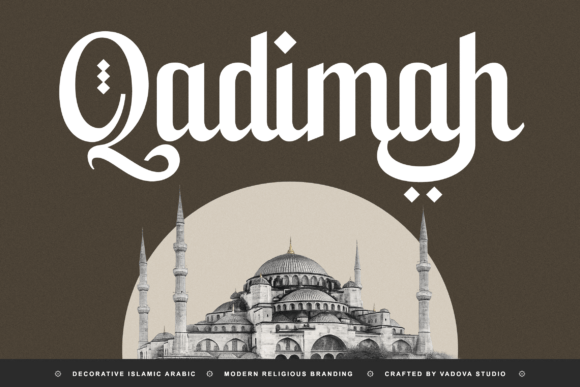
For marketers, publishers, and brand identity specialists, typography is the voice of visual communication. When that voice needs to convey respect, tradition, and elegance simultaneously, generic solutions often fall flat. Qadimah provides a distinctive solution by integrating teardrop terminals and diamond-shaped diacritic accents directly into Latin letterforms. This synthesis creates an immediate visual association with Islamic art and architecture, allowing brands to establish a specific cultural context instantly. Whether you are designing a wedding invitation, a museum exhibition catalog, or a luxury product label, this typeface delivers a graceful yet bold presence that commands attention across both print and digital media.
Defining Characteristics and Visual Anatomy
To use Qadimah effectively, one must understand what distinguishes it from standard serif families. The typeface does not simply mimic Arabic script; it translates the spirit of the script into a Latin framework. The most notable feature is the integration of diamond-shaped accents. In traditional Arabic calligraphy, the rhombic dot (nuqta) is a fundamental unit of proportion and rhythm. Qadimah adapts this geometric motif as diacritic marks and decorative flourishes within the English alphabet. This subtle detail signals authenticity to those familiar with the tradition while remaining aesthetically pleasing to general audiences.
The letterforms themselves feature elegant curves and high-contrast strokes typical of modern serifs, but with softened transitions that echo the fluid motion of a reed pen. The teardrop terminals serve as a nod to Naskh and Thuluth scripts, providing a sense of directionality and flow even in static text. Unlike heavily stylized blackletter or faux-Arabic fonts that can appear caricatured or illegible at smaller sizes, Qadimah maintains structural integrity. The x-height is generous enough to ensure legibility in headlines and subheads, making it a practical choice for editorial layouts where reading speed matters alongside aesthetic impact.
Strategic Applications in Branding and Identity
In the competitive landscape of branding, distinctiveness is currency. For businesses operating in sectors like modest fashion, halal finance, Islamic education, or Middle Eastern hospitality, visual identity must align with core values. Using Qadimah in a logo or wordmark allows a company to signal its cultural alignment without relying on clichéd iconography like crescents or arches. The font carries the cultural weight internally, freeing up other design elements to be more minimalist or abstract.
- Luxury Packaging: The refined serif structure pairs exceptionally well with gold foil stamping and textured papers, elevating perfumes, confectionery, and cosmetics.
- Cultural Institutions: Museums and galleries can use the typeface for exhibition titles and wayfinding to create an immersive atmosphere that respects the subject matter.
- Hospitality Signage: Hotels and restaurants specializing in Middle Eastern cuisine can utilize Qadimah for menus and entrance signage to set expectations before the guest even enters.
- Publishing Covers: Book designers can leverage the font’s strong personality for titles in historical fiction, poetry collections, or academic texts regarding Islamic studies.
When implementing Qadimah in branding, consider it a "display" asset rather than a workhorse. It shines brightest when given space to breathe. Pairing it with a clean, neutral sans-serif for body copy creates a necessary contrast that enhances the decorative qualities of the headline while ensuring the supporting information remains accessible. This hierarchy is crucial for maintaining professional standards in commercial design.
Editorial and Digital Implementation
Beyond static branding, Qadimah offers significant value in digital environments where engagement is paramount. Social media graphics, blog headers, and email newsletters benefit from typography that stops the scroll. In an era of homogenized web design, a font with such specific character acts as a pattern interrupt. However, digital implementation requires technical mindfulness. Because the font includes intricate details like diamond accents and fine curves, rendering can vary across screens.
Designers should test Qadimah across multiple devices and browsers to ensure the ornamental details do not pixelate or disappear at lower resolutions. It performs best at larger pixel densities, making it ideal for hero images, pull quotes, and section dividers. For content creators and bloggers focusing on Ramadan campaigns, Eid celebrations, or cultural commentary, using this typeface adds a layer of production value that stock photography alone cannot achieve. It transforms a standard post into a curated visual experience.
Practical Considerations for Selection and Usage
While Qadimah is versatile within its niche, it is not a universal solution. Understanding its limitations is just as important as recognizing its strengths. As a display font, it is optimized for short bursts of text. Setting paragraphs in Qadimah will fatigue the reader and diminish the font's decorative impact. Reserve it for titles, captions, drop caps, and short phrases. If your project requires extensive bilingual typesetting, verify how Qadimah interacts with actual Arabic script. While designed to harmonize visually, you may need to adjust tracking or baseline shifts to create a seamless optical line between the two writing systems.
Licensing and accessibility are also critical factors for professionals. Always ensure your license covers the intended medium, especially for commercial digital products or app embedding. From an accessibility standpoint, avoid using Qadimah for essential navigational elements or critical instructions. Its decorative nature, while beautiful, reduces scanning efficiency compared to standard grotesques or humanist sans-serifs. Use it to enhance the emotional tone of the interface, not to dictate function.
Color selection further influences the perception of this typeface. Deep emeralds, navy blues, warm terracottas, and metallic tones naturally complement the Islamic-inspired geometry. High-contrast combinations, such as cream text on a charcoal background, allow the delicate teardrop terminals to remain crisp. Conversely, low-contrast pastel palettes may cause the finer details to recede, reducing legibility. Testing color pairings in context is a non-negotiable step in the evaluation process.
Enhancing Communication Through Cultural Resonance
Ultimately, the value of Qadimah lies in its ability to facilitate better communication. Typography is never neutral; it carries historical and emotional baggage. By choosing a typeface that thoughtfully integrates cultural markers rather than appropriating them superficially, designers demonstrate respect and intentionality. This builds trust with target audiences who are increasingly sensitive to authentic representation versus stereotyping.
For educators and non-profit organizations, this distinction is vital. Materials produced with Qadimah feel bespoke and considered, suggesting that the organization has invested time in understanding the community it serves. This perceived effort translates directly into engagement and credibility. In commercial contexts, it elevates the perceived value of the product or service. A menu set in Qadimah suggests a dining experience that is curated and traditional; a report cover set in Qadimah suggests scholarship and depth.
Integrating Qadimah into your typographic toolkit expands your creative vocabulary. It challenges the default reliance on safe, ubiquitous typefaces and encourages a more nuanced approach to cultural design. Whether you are a freelance designer looking to specialize in multicultural branding or a business owner seeking to refresh your visual identity, this typeface offers a sophisticated pathway to connecting heritage with modernity. By balancing ornamental beauty with structural discipline, Qadimah proves that cultural specificity and contemporary design excellence are not mutually exclusive—they are complementary forces that, when aligned, produce truly memorable work.