Anvil Font: Forging Legendary Visual Identities
Typography carries weight, both visually and emotionally. When a design project demands a presence that feels ancient, rugged, and undeniably bold, standard serifs often fall short. They may be elegant or readable, but they rarely convey the visceral texture of hammered metal or the mythic gravity of dark fantasy. This is where Anvil distinguishes itself as a specialized tool for creators. Anvil is not merely a display font; it is a stylistic statement that bridges the gap between historical blacksmith craftsmanship and modern aggressive branding.
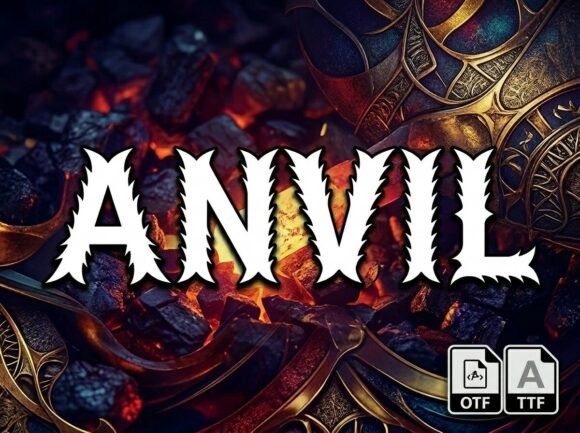
At its core, Anvil captures a mythic-and-metallic soul through high-contrast letterforms that refuse to be ignored. The typeface is defined by rhythmic, hand-drawn jagged-edge contours and sharp, horn-like serifs. These are not digital artifacts or distressed overlays applied as an afterthought. The irregularity is baked into the vector structure, mimicking the organic imperfections of iron shaped by fire and force. For designers, marketers, and hobbyists working within niche genres, this authenticity provides a foundational aesthetic that generic "grunge" fonts cannot replicate.
The Anatomy of Aggressive Elegance
Understanding why Anvil works requires looking at how it balances heavy structural weight with intricate detail. In typography, high contrast usually implies elegance, seen in fashion editorials or luxury packaging. Anvil subverts this expectation. It retains the dramatic thick-and-thin stroke modulation of traditional serif design but applies it to a form language rooted in industrial labor and folklore.
The jagged edges serve a dual purpose. Visually, they create a texture that interacts beautifully with negative space, preventing large headlines from appearing as solid, impenetrable blocks. Thematically, they suggest age, wear, and survival. The horn-like serifs act as anchors, giving each character a stance that feels planted and immovable. This combination makes Anvil exceptionally legible at large sizes while retaining enough complexity to reward closer inspection. It avoids the trap of being purely decorative; the letterforms remain functional, ensuring that your message is read before it is merely admired.
Applications in Tabletop and Game Design
Independent tabletop RPG publishers face a unique challenge: creating books that feel like artifacts rather than manuals. Players want immersion from the moment they open the PDF or hardcover. Anvil serves as an ideal choice for chapter titles, class names, and spell headers within fantasy rulebooks. Its heavy weight establishes hierarchy instantly, guiding readers through dense mechanical text without competing with the body copy.
Beyond the interior layout, consider the marketing materials for these games. Social media headers and Kickstarter campaign banners require immediate impact in small thumbnails. The aggressive personality of Anvil ensures readability even when scaled down on mobile devices. For game masters creating custom handouts or prop documents, pairing Anvil with a clean, neutral sans-serif for body text creates a professional yet thematic contrast. The font signals to players that the content within is serious, grounded, and steeped in lore.
Branding for Artisans and Makers
For bladesmiths, leatherworkers, and metal artists, visual identity must reflect physical reality. A sleek, minimalist logo can sometimes feel disconnected from the soot, heat, and manual effort of the workshop. Anvil offers a typographic voice that aligns with the maker’s process. When designing a logo for a forge or artisanal brand, the hand-drawn quality of the font suggests human involvement. It tells customers that the products are crafted, not mass-produced.
Practical application here extends beyond logos. Consider using Anvil for product stamps, packaging labels, or business cards. Because the font features inherent texture, it reproduces well on uncoated papers and raw cardstocks, where the ink absorption enhances the jagged aesthetic. However, restraint is necessary. As a display face, Anvil should be reserved for the brand name and key taglines. Supporting elements like contact information, prices, and specifications require a simpler typeface to maintain clarity and accessibility. Let Anvil be the hammer; let other fonts be the anvil upon which the information rests.
Metal Music and Dark Fantasy Aesthetics
The intersection of music and visual art is perhaps where Anvil finds its most natural home. Metal band album art, concert posters, and merchandise demand typography that matches the sonic intensity of the genre. While many metal bands opt for illegible logotypes, Anvil provides a solution for secondary text that maintains the atmosphere without sacrificing communication. It works effectively for album titles, track listings, and tour dates where legibility is legally or practically required.
Designers in this space can experiment with color and treatment to push the font further. Metallic gradients, embossing effects, and high-contrast duotones amplify the inherent qualities of the letterforms. Because the contours are already jagged, adding subtle noise or grain textures blends seamlessly rather than looking artificial. This makes Anvil versatile across different subgenres, from the rustic warmth of folk metal to the cold precision of industrial. It adapts to the mood set by the accompanying imagery, serving as a flexible anchor in chaotic compositions.
Best Practices for Implementation
To maximize the effectiveness of Anvil, designers must respect its role as a display typeface. Its heavy weight and complex edges mean it performs poorly at small sizes. A practical minimum size threshold should be established during the testing phase; if the jagged details begin to bleed together or the counters fill in, the text is too small. Always prioritize function over style. If a viewer cannot read the header quickly, the aesthetic victory is pyrrhic.
Pairing is equally critical. Anvil has a massive visual footprint. Balance it with typefaces that are structurally simple and open. Geometric sans-serifs or traditional humanist serifs work best because they provide a quiet backdrop that allows Anvil to resonate. Avoid pairing it with other distressed, grunge, or highly decorative fonts. Competing textures create visual noise and fatigue. Instead, use whitespace generously. The silence around an Anvil headline amplifies its volume.
- Limit Usage: Restrict Anvil to headlines, logos, and short callouts. Never use it for paragraphs or extended reading.
- Mind the Kerning: Due to the irregular serifs, manual kerning adjustments are often necessary to prevent awkward collisions or excessive gaps between specific letter pairs.
- Test Across Media: Verify legibility in both digital RGB and print CMYK contexts. Screen rendering can sometimes soften jagged edges, while print can sharpen them unexpectedly.
- Contextual Color: High contrast colors (black on white, white on black) showcase the silhouette best. Mid-tone backgrounds may obscure the fine edge details.
Crafting Authentic Narratives
Ultimately, choosing Anvil is a decision about storytelling. It is a rejection of polished corporate uniformity in favor of something that feels earned. Whether you are designing a social media header for a rugged outdoor brand, laying out a zine about medieval history, or branding a new line of hand-forged tools, the font acts as a shorthand for authenticity. It communicates values of strength, tradition, and individuality before a single word is processed cognitively.
Creators should view Anvil not just as a collection of glyphs, but as a collaborative element in the design process. Its distinct personality invites specific creative directions. It encourages darker color palettes, textured backgrounds, and illustrative styles that echo its hand-drawn nature. By understanding the specific strengths and limitations of this typeface, designers can forge identities that are not only visually striking but deeply resonant with their intended audiences. In a digital landscape saturated with smooth, interchangeable aesthetics, the rough, legendary soul of Anvil offers a powerful way to stand apart.