Evaluating Coots: A Technical Display Typeface for Digital Distortion
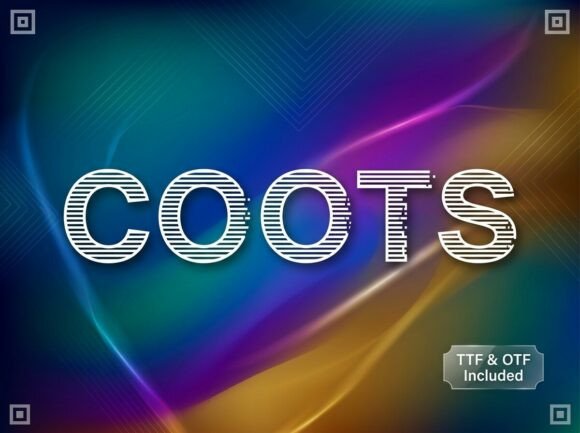
Selecting typography for futuristic or tech-centric projects requires balancing aesthetic impact with functional clarity. Coots is a high-tech display typeface designed specifically to address this balance within niche visual contexts. It captures a scanned-and-distorted soul through bold sans-serif letterforms constructed from rhythmic horizontal scan lines and subtle glitch offsets. Unlike standard geometric sans-serifs, Coots simulates the imperfections of digital transmission, making it a distinct option for designers working in cyberpunk branding, electronic music promotion, and experimental interface design. This evaluation explores the practical applications, technical considerations, and strategic fit of Coots for contemporary digital projects.
Defining the Visual Mechanics of Coots
To determine if Coots aligns with project requirements, one must first understand its construction. The typeface does not merely apply a post-production filter to existing glyphs; the distortion is intrinsic to the vector structure. The letterforms are built upon a grid of horizontal scan lines, creating a texture that mimics cathode ray tube (CRT) displays or corrupted data streams. The "glitch offsets" are meticulously placed rather than randomized, ensuring that the font maintains structural integrity even at smaller display sizes.
This deliberate construction differentiates Coots from generic grunge or distressed fonts. While many distressed typefaces sacrifice legibility for texture, Coots retains the skeletal geometry of a bold sans-serif. This allows it to function as a primary headline typeface rather than solely as a background texture element. The rhythmic nature of the scan lines provides a consistent visual cadence, which is essential when setting longer phrases or integrating the type into complex layouts where visual noise must be controlled.
Strategic Applications and Use Cases
Coots serves specific communicative functions within design systems. Its utility is highest in environments where the medium itself is part of the message. Designers evaluating this typeface should consider its efficacy in the following contexts:
- Cyberpunk and Sci-Fi Branding: For independent brands operating within speculative fiction aesthetics, Coots provides immediate genre signaling without relying on clichéd neon effects. The font carries the narrative weight of a dystopian or high-tech future through its form alone.
- Electronic Music Artwork: Album covers and event posters for genres like IDM, techno, and synthwave benefit from the typeface’s inherent rhythm. The horizontal scan lines complement audio waveforms and frequency visualizations, creating a cohesive audiovisual identity.
- Futuristic Interface Design (FUI):strong> In motion graphics and game UI design, Coots works effectively for diegetic text elements. It sells the illusion of an in-world screen or holographic projection better than clean system fonts, adding depth to user interfaces that represent advanced technology.
- Social Media Headers and Data Visualization: For content creators focusing on tech commentary or data storytelling, Coots offers a way to stylize headers that suggests information processing. It pairs well with raw data aesthetics, reinforcing themes of digital analysis and transmission.
Benefits and Functional Advantages
The primary advantage of Coots is its ability to convey technological atmosphere without external manipulation. Using standard fonts often requires designers to spend significant time applying displacement maps, noise filters, or rasterization effects to achieve a similar look. These post-processing techniques can degrade vector quality and increase file size. Coots delivers this aesthetic natively in vector format, ensuring crisp rendering across various resolutions and simplifying the production workflow.
Furthermore, the typeface offers strong hierarchy potential. Because the distortion is subtle and rhythmic, Coots remains readable enough for subheads and short body copy in large-format print, unlike more aggressive glitch fonts that are limited to single words. This versatility allows designers to build a more unified typographic system using a single family, reducing the cognitive load associated with pairing multiple disparate display faces.
Tradeoffs and Technical Considerations
Despite its strengths, Coots presents specific limitations that must be weighed during the selection process. The most significant tradeoff is readability at small scales. The horizontal scan lines create negative space that can cause the letters to break apart or vibrate visually when scaled down below 24 points on screen or 18pt in print. It is strictly a display typeface and should never be used for extended reading or functional UI labels.
Accessibility is another critical consideration. The inherent distortion reduces contrast sensitivity and character recognition speed. When using Coots in web environments or public signage, designers must ensure sufficient color contrast against the background and provide accessible alternatives. Relying on Coots for essential navigation or safety information is inadvisable. Additionally, the busy texture of the font can clash with detailed photography or complex illustrations. It performs best against solid colors, gradients, or minimalist backgrounds where the scan lines do not compete with underlying visual information.
When to Consider Alternatives
Evaluating Coots also involves recognizing when a different solution is superior. If a project requires a blend of retro-futurism and corporate professionalism, Coots may be too informal or chaotic. In such cases, a clean geometric sans-serif paired with a separate glitch overlay might offer more flexibility, allowing the designer to toggle the distortion on or off based on context.
For projects focused on organic futurism or biotech aesthetics, the rigid, mechanical scan lines of Coots may feel incongruent. Typefaces featuring fluid curves, variable axes, or organic textures would better communicate biological or ecological themes. Similarly, if the goal is pure minimalism or Swiss-style neutrality, the decorative nature of Coots introduces unnecessary noise. Understanding these boundaries prevents the misapplication of the typeface in contexts where its stylistic traits undermine the communication goals.
Decision-Making Framework for Selection
Designers and art directors can use the following criteria to finalize their decision regarding Coots:
- Audit the Hierarchy: Does the project require a headline font that conveys digital interference? If the primary need is body text or microcopy, discard Coots immediately.
- Assess the Background Environment: Test the font against the intended background assets. If the scan lines disappear or create moiré patterns with existing textures, the integration will fail regardless of the font's standalone quality.
- Evaluate Brand Tone: Determine if the brand voice aligns with "transmission in progress." Coots implies instability, movement, and raw data. If the brand values stability, permanence, and polished luxury, this typeface creates a tonal dissonance.
- Test Cross-Platform Rendering: Verify how the thin horizontal strokes render on target devices. Low-resolution screens may alias the scan lines poorly. If the primary audience uses low-DPI displays, conduct rigorous testing before commitment.
Ultimately, Coots is a specialized tool for specific narrative and aesthetic challenges. It excels when the design intent involves capturing the friction of digital media, the rhythm of electronic sound, or the raw aesthetic of data transmission. By understanding both its meticulous construction and its operational constraints, designers can leverage Coots to create impactful, tech-forward visuals that resonate with audiences attuned to the nuances of digital culture. The decision to adopt Coots should be driven by a clear alignment between its unique distorted morphology and the project's core communicative objectives.