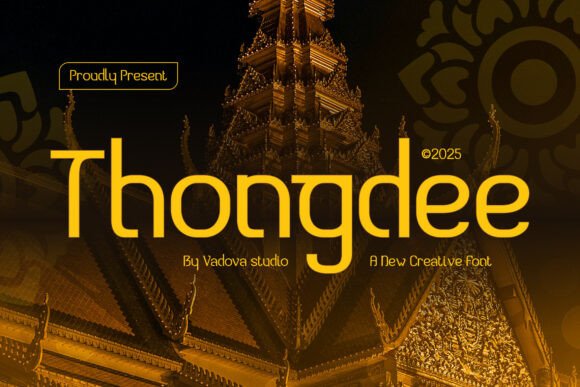
Thongdee Typeface: Bridging Traditional Thai Heritage and Modern Digital Design
In the vast landscape of typography, certain typefaces do more than simply convey text; they tell a story of culture, history, and artistic evolution. Thongdee is one such distinctive display typeface that has captured the attention of designers seeking to infuse their work with authentic cultural resonance. Inspired deeply by traditional Thai visual culture, Thongdee represents a sophisticated dialogue between the past and the present. It is not merely a font but a modern interpretation of heritage aesthetics, featuring smooth curves, rounded terminals, and ornamental detailing that pays homage to classical craftsmanship while remaining fully functional in contemporary design environments.
For general readers, students, and professional creatives alike, understanding Thongdee offers a window into how traditional art forms can be adapted for modern utility. This article explores the significance, technical construction, and practical applications of this unique typeface, clarifying why it stands out in an era of minimalist sans-serifs and generic display fonts.
The Cultural Roots of Thongdee’s Aesthetic
To truly appreciate Thongdee, one must first understand the visual language from which it emerges. Traditional Thai art and architecture are renowned for their intricate fluidity. Unlike the rigid geometry often found in Western industrial design, Thai visual culture emphasizes organic movement, graceful arcs, and elaborate ornamentation. These elements are historically visible in temple murals, royal manuscripts, and traditional dance costumes.
Thongdee translates these physical attributes into digital letterforms. The smooth curves and rounded terminals characteristic of this typeface are direct descendants of the brush strokes used in traditional Thai calligraphy and painting. However, rather than creating a historical replica, the designers have reinterpreted these motifs for a modern audience. The result is a typeface that feels familiar and respectful to those who know the culture, yet fresh and accessible to international viewers. This balance is crucial; it prevents the design from becoming a caricature or a cliché, instead positioning it as a legitimate evolution of typographic heritage.
Defining Characteristics: Ornamentation Meets Readability
A common misconception about culturally inspired display fonts is that they sacrifice legibility for decoration. While highly ornamental scripts exist, Thongdee is engineered differently. It is categorized as a display typeface, meaning it is optimized for headlines, titles, and short-form text where impact is paramount. Despite its decorative identity, readability remains a core priority.
- Balanced Proportions: Each character is carefully crafted to maintain consistent spacing and weight, ensuring that words read as cohesive units rather than disjointed illustrations.
- Refined Ornamentation: The decorative details are integrated into the structure of the letters themselves, rather than applied as superficial overlays. This ensures the font retains clarity even at smaller display sizes.
- Modern Silhouette: While the internal details reference tradition, the overall silhouette of the characters adheres to modern typographic standards, making it compatible with contemporary layout grids.
Technical Versatility Across Media
One of the most significant aspects of Thongdee is its seamless adaptability across print and digital environments. In the early days of digital typography, culturally specific fonts were often technically limited, lacking proper kerning, hinting, or character sets. Thongdee overcomes these historical limitations through high-quality engineering.
The font includes a complete set of uppercase and lowercase characters, numerals, and punctuation. This comprehensive character set is essential for professional use. A display font that lacks lowercase letters or proper punctuation forces designers to awkwardly mix typefaces, breaking visual harmony. By providing a full suite of glyphs, Thongdee allows for versatile typographic hierarchies within a single family.
Multilingual Support and Global Application
In our interconnected world, typography must often transcend linguistic borders. Thongdee supports multilingual characters, a feature that significantly expands its utility. For businesses operating in Southeast Asia or global brands targeting Thai-speaking demographics, this support ensures that branding remains consistent across languages. It eliminates the jarring visual disconnect that occurs when a brand uses a custom English display font but is forced to revert to a standard system font for Thai translations.
This technical robustness makes Thongdee suitable for various deliverables, including:
- High-Resolution Print: Packaging, posters, and editorial spreads where vector precision is required.
- Digital Interfaces: Web headers, social media graphics, and app splash screens.
- Motion Graphics: Video titles and animated typography where the smooth curves render beautifully in motion.
Practical Applications in Business and Creativity
Understanding the theory behind Thongdee is valuable, but seeing its practical relevance helps clarify its role in daily creative work. Where does this typeface actually fit in a modern workflow?
Branding and Identity Design
For brands rooted in Thai culture—such as hospitality groups, wellness spas, artisanal food producers, or cultural institutions—Thongdee serves as an immediate signifier of authenticity. It communicates "Thai heritage" without resorting to stereotypical imagery like elephants or lotus flowers. Instead, the typography itself carries the cultural weight. For international brands entering the Thai market, using Thongdee demonstrates a commitment to localization and respect for local aesthetics, which can foster deeper consumer trust.
Editorial and Event Design
In editorial design, Thongdee excels as a headline face for articles covering travel, culture, history, or lifestyle. Its distinctive personality draws the reader's eye and sets the tone for the content that follows. Similarly, for event design—such as wedding invitations, festival posters, or exhibition catalogs—the font adds a layer of elegance and formality that standard serif or sans-serif fonts cannot achieve. The rounded terminals evoke warmth and welcome, making it particularly effective for events centered on community and celebration.
Educational and Cultural Projects
Educators and researchers working on materials related to Southeast Asian studies can utilize Thongdee to create visually engaging presentations and publications. Using a typeface that reflects the subject matter enhances the learning experience by aligning form with content. It helps students and audiences visually connect with the material, reinforcing the cultural context through the very shape of the text.
Clarifying Common Misunderstandings
As with any specialized design tool, there are assumptions about Thongdee that require clarification to ensure effective use.
Misconception 1: It is only for Thai-language text.
While inspired by Thai culture, Thongdee is primarily a Latin-script display typeface (unless specified otherwise in specific product variations). It is designed to bring Thai aesthetic sensibilities to English and other Latin-based languages. This distinction is vital; you do not need to speak Thai to use it effectively. It is a stylistic choice, not just a linguistic utility.
Misconception 2: Display fonts are unusable in digital formats.
Historically, ornate fonts rendered poorly on low-resolution screens. Thongdee is delivered in high-quality font files optimized for modern rendering engines. When used appropriately—at adequate sizes and with proper contrast—it performs exceptionally well on websites and mobile devices.
Misconception 3: Cultural fonts are outdated.
Thongdee proves the opposite. By stripping away excessive clutter and focusing on smooth, modern curves, it demonstrates that heritage aesthetics can be forward-looking. It fits seamlessly alongside contemporary minimalist design elements, acting as a focal point rather than a relic.
Best Practices for Implementation
To maximize the effectiveness of Thongdee, designers should adhere to a few best practices. Because it is a display typeface with significant personality, it pairs best with neutral, clean body text. A simple geometric sans-serif or a humanist serif often provides the necessary contrast to let Thongdee shine without competing for attention.
Additionally, consider the negative space. The ornamental detailing in Thongdee requires breathing room. Cramping the tracking or leading can cause the decorative elements to merge, reducing legibility and visual elegance. Generous whitespace around headlines set in Thongdee enhances the perception of luxury and refinement.
Finally, always verify licensing for commercial use. High-quality typefaces like Thongdee are intellectual property, and supporting the creators ensures the continued development of culturally significant design tools. Whether used for a multinational marketing campaign or a personal art project, respecting the craft behind the font honors the tradition it represents.
Conclusion
Thongdee is more than a collection of vector shapes; it is a testament to the enduring power of cultural adaptation. By merging the smooth curves and ornamental richness of traditional Thai visual culture with the technical demands of modern typography, it offers designers a powerful tool for storytelling. It bridges the gap between heritage and innovation, proving that looking backward can be a vital step in moving forward. For anyone looking to add depth, warmth, and cultural specificity to their visual communications, Thongdee provides a distinctive, readable, and deeply meaningful solution.