Jacob: Evaluating a Premium Typeface for Modern Gothic Design
In the crowded landscape of display typography, finding a typeface that successfully bridges historical aesthetics with contemporary utility is a genuine challenge. Jacob emerges as a significant contender in this niche, offering a distinct visual voice that merges medieval structural integrity with modern sharpness. For designers and brand strategists operating within luxury, fantasy, or alternative markets, Jacob represents more than just a stylistic choice; it is a functional tool for establishing authority and atmosphere. Unlike novelty fonts that sacrifice legibility for theme, Jacob maintains professional graphic weight, making it a viable option for serious commercial projects ranging from high-end occult branding to complex RPG interface design.
Defining the Visual Architecture
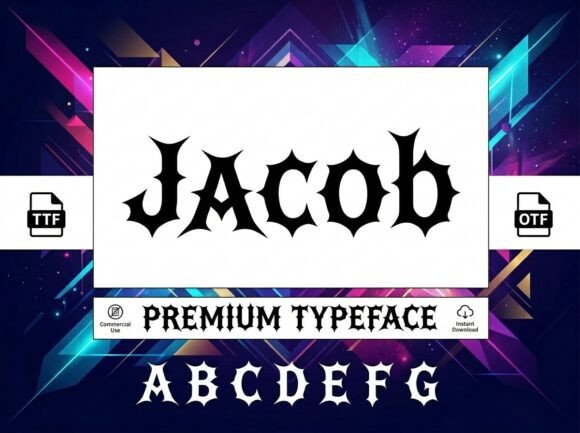
Jacob is best understood as a hybrid specimen. It does not strictly adhere to traditional Blackletter or Textura classifications, nor does it fully embrace modern sans-serif geometry. Instead, it occupies a deliberate middle ground. The letterforms are bold and symmetrical, providing a stable foundation that feels engineered rather than merely drawn. This symmetry is crucial for digital applications where pixel alignment and screen rendering can often distort intricate details.
The defining characteristic of Jacob is its integration of "vampiric thorns" and dramatic points. These elements are not applied as superficial overlays but appear intrinsic to the stroke construction. The terminals and apexes feature sharp, aggressive tapers that evoke gothic architecture and ironwork. This creates a dual impression: the font feels regal due to its upright posture and balanced proportions, yet dangerous due to its pointed extremities. For art directors, this duality solves a common problem in dark aesthetic design—how to convey edge without appearing amateurish or chaotic. Jacob achieves a controlled menace that reads as premium rather than punk.
Practical Applications in Branding and Media
The true value of any display typeface lies in its specific use cases. Jacob’s design parameters make it exceptionally well-suited for several distinct industries where tone is paramount.
Luxury Occult and Alternative Markets
The market for spiritual, esoteric, and alternative luxury goods has matured significantly. Consumers in this demographic expect packaging and digital touchpoints that reflect sophistication. Jacob serves this sector effectively because it avoids the cliché "Halloween" aesthetic often associated with gothic fonts. Its clean lines and substantial weight allow it to function on perfume bottles, tarot deck packaging, and high-end jewelry branding. The typeface commands attention at large sizes while retaining enough clarity to remain identifiable on smaller product labels, provided it is used exclusively for headlines and logos.
Cinematic Fantasy and Entertainment
For title sequences, book covers, and promotional materials in the fantasy genre, readability at a glance is non-negotiable. Jacob’s bold structure ensures that titles remain legible against busy backgrounds or video footage. The architectural soul of the font pairs naturally with world-building narratives, suggesting history and lore without requiring additional illustrative elements. It performs particularly well in vertical compositions, such as movie posters or streaming service thumbnails, where the tall aspect ratio maximizes screen real estate.
Dark RPG and Game Interface Design
User interface (UI) design for role-playing games requires a delicate balance between immersion and usability. While Jacob is too ornate for body text or inventory stats, it excels as a header font for menus, quest logs, and chapter titles. Its sharp points and heavy strokes create clear visual hierarchy, guiding players through complex information systems without breaking the atmospheric spell. The font’s consistency across characters ensures that dynamic text generation in-game engines does not result in awkward spacing or alignment issues.
Evaluating Usability and Technical Performance
Aesthetic appeal must be backed by technical reliability. In practical workflow testing, Jacob demonstrates several strengths that contribute to long-term value.
- Optical Balance: Despite the decorative thorns, the core counter shapes are open and consistent. This prevents the "muddy" appearance that plagues many blackletter-inspired fonts when scaled down or viewed on lower-resolution displays.
- Kerning and Spacing: The typeface appears to have been spaced with digital headers in mind. The sidebearings accommodate the dramatic points without creating excessive whitespace between letters, reducing the need for manual tracking adjustments in layout software.
- Versatility in Weight: The bold nature of the primary cut provides sufficient contrast against both light and dark backgrounds. This reduces dependency on drop shadows or outlines to achieve separation, resulting in cleaner final outputs.
- Cross-Platform Rendering: The vector construction is precise, ensuring that the sharp points do not artifact or blur when exported for web use or motion graphics.
However, professionals should approach Jacob with an understanding of its limitations. It is strictly a display face. Attempting to use it for paragraphs, captions, or data-heavy tables will degrade user experience and accessibility. Furthermore, its strong personality means it dominates layouts; pairing it requires care. Neutral geometric sans-serifs or clean humanist serifs typically work best as supporting typefaces, allowing Jacob to serve as the singular focal point without competing for attention.
Strategic Considerations for Creative Professionals
When evaluating whether to integrate Jacob into a design system or project library, consider the longevity of the asset. Trend-based gothic fonts often cycle out of fashion quickly, but Jacob’s reliance on architectural principles rather than fleeting pop-culture references suggests better staying power. It aligns with the broader design trend of "modern heritage," where historical motifs are refined through contemporary minimalism.
For freelancers and agency designers, owning a license for Jacob can streamline the concepting phase for dark-themed projects. Having a reliable, high-quality gothic option eliminates hours spent sifting through low-quality free alternatives that require extensive cleanup or modification. The time saved in production and the elevated quality of client presentations can justify the investment.
It is also worth noting the psychological impact of this specific typographic style. The combination of symmetry and sharpness triggers associations with precision, exclusivity, and intensity. In marketing contexts, this can subtly reinforce brand positioning. A skincare line using Jacob signals potent, active ingredients rather than gentle, organic soothing. A podcast using Jacob signals rigorous analysis of dark topics rather than casual storytelling. Understanding these semiotic cues allows designers to leverage the font as a strategic communication tool, not just a decorative layer.
Making the Final Assessment
Jacob stands out in the premium typeface market because it respects the intelligence of its audience and the demands of professional workflows. It offers a sophisticated interpretation of the gothic aesthetic that feels relevant to current design sensibilities. While it is not a universal solution for every project, its specialized strengths make it an invaluable asset for those working in luxury, entertainment, and alternative subcultures.
Ultimately, the decision to use Jacob should be driven by project requirements and audience expectations. If the goal is to command attention with a look that is simultaneously regal and dangerous, few contemporary options execute this balance as effectively. By treating Jacob as a precision instrument for headline and identity work, designers can harness its full potential to create memorable, impactful visual experiences that resonate with discerning audiences. The font delivers on its promise of blending medieval structure with modern sharpness, proving that historical inspiration, when executed with discipline, remains a powerful force in modern graphic design.